 SCIENCE · OUR PLANET
The sounds of our ocean
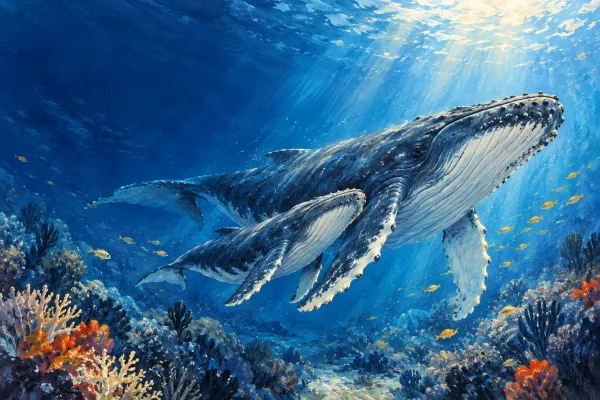
Whales have a lot to say. But what happens when their underwater world gets noisy?
♫ 1-minute story✎ 3 responsesWords & transcript included
A little listening. A new perspective.
 Ryan Bollenbach
The story, the question and the next step on one screen
Listenwise was a consulting engagement. The prototype and proposals on this page are a later concept exploration of the student assignment flow, based on reviewing the live product.
YOUR CLASSROOM, YOUR CURIOSITY
There’s a whole world out there. Let’s listen to it.
SCIENCE · OUR PLANETWhales have a lot to say. But what happens when their underwater world gets noisy?
STAGE 1 · BEFORE YOU LISTEN
Watch a short 25-second primer, then explore the key words before starting the audio story.
Under the waves, sound travels nearly five times faster than through air.
In deep ocean water, sunlight disappears fast. Whales rely on sound vibrations to navigate murky depths, hunt for food, and stay in touch over huge distances.
Quick think: What makes sound so powerful under water?
VOCABULARY PREVIEW
Tap any card to flip its meaning and hear the pronunciation before listening.
/kə-myoo-nə-kayt/
Tap to flip & read meaning ↻To share information, warnings, or feelings with others using signals or sounds.
In this story: “Whales communicate across miles of open ocean using low vocal calls.”
Tap to flip back ↺/ek-oh-loh-kay-shən/
Tap to flip & read meaning ↻Finding where things are by sending out sound waves and listening to the echoes that bounce back.
In this story: “Like a flashlight made of sound, echolocation lets whales map out the dark sea.”
Tap to flip back ↺/ev-ə-dəns/
Tap to flip & read meaning ↻Specific facts, details, or quotes that support an answer or claim.
In this story: “Look for evidence of how human ship engines interfere with whale calls.”
Tap to flip back ↺These definitions will stay available in your Word Explorer while listening.
LISTEN & EXPLORE
Follow your curiosity. Replay anything you need.
A small story. A big blue world.
An original demo storyAudio couldn’t play. You can still read the story below.
A little help with the big ideas.
Whales use sound to communicate.
Dolphins and whales use sound like a flashlight.
The whale’s call is one piece of evidence.
You don’t need perfect words. Start with what you heard.
Use a detail from the story in your answer.
MAKE CONNECTIONS
Connect the story to a world you know.
Describe what makes listening difficult, and one thing that could help.
STAGE 4 · REVIEW & FINISH
Read your answers together. Change anything you’d like.
Your notebook is ready. Submitting will turn in your work to Ms. Rivera.
Ms. Rivera’s 5th Grade Science class
You’re about to turn in your listening notebook for The sounds of our ocean.
✓NICELY DONE, MAYA · SUBMITTED TO MS. RIVERA
Your assignment has been submitted to Ms. Rivera’s 5th Grade Science class.
The problem
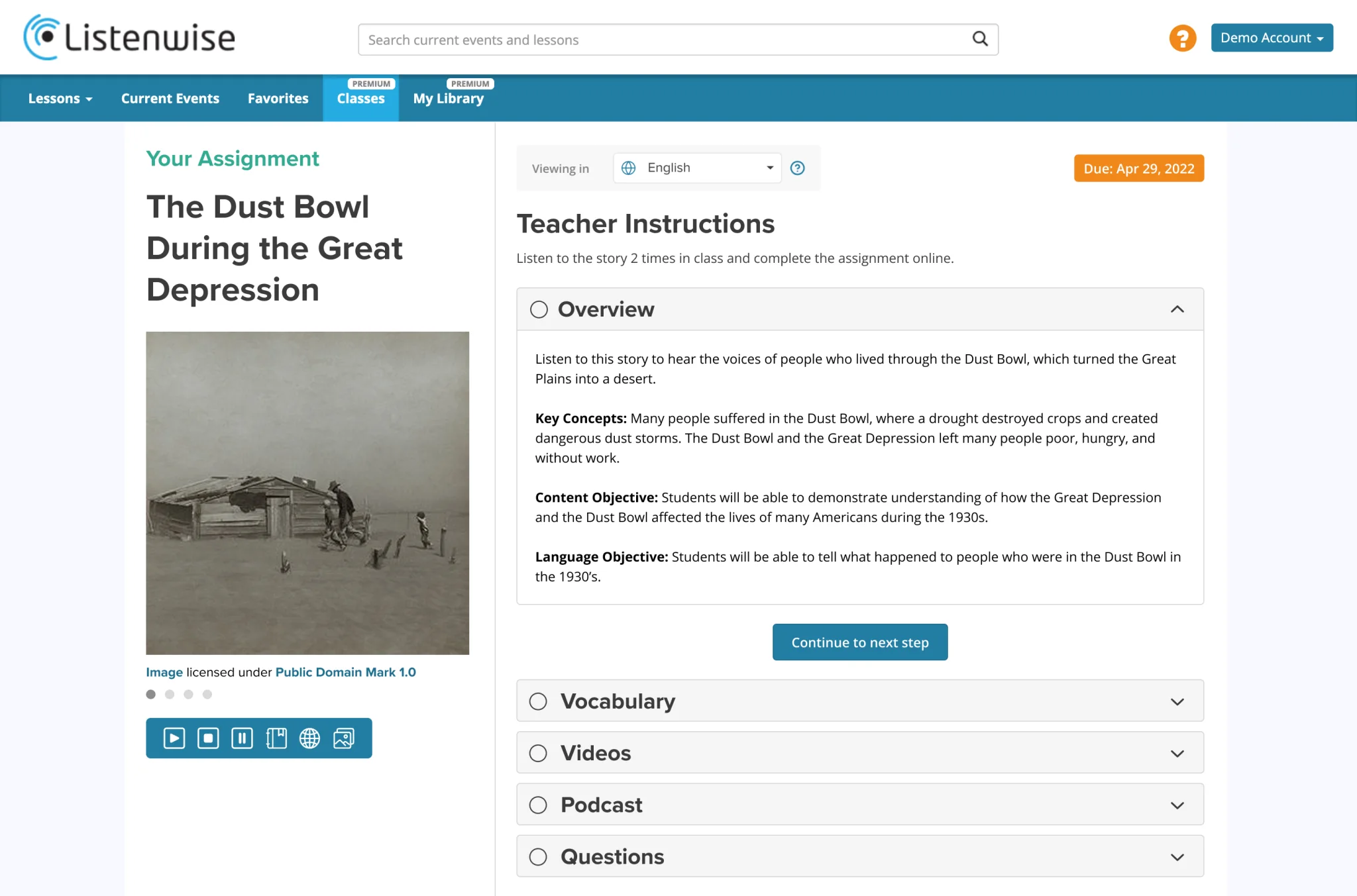
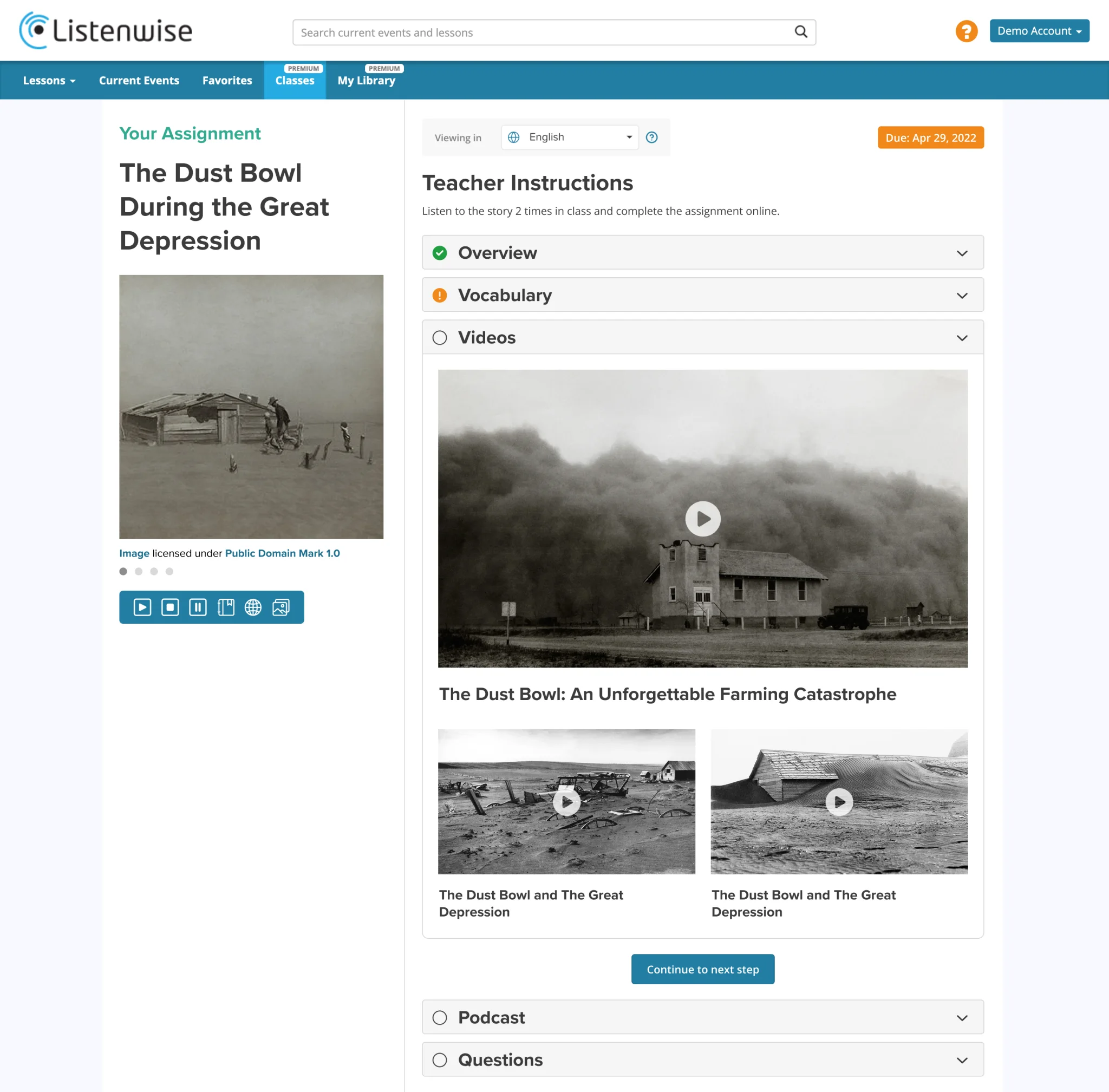
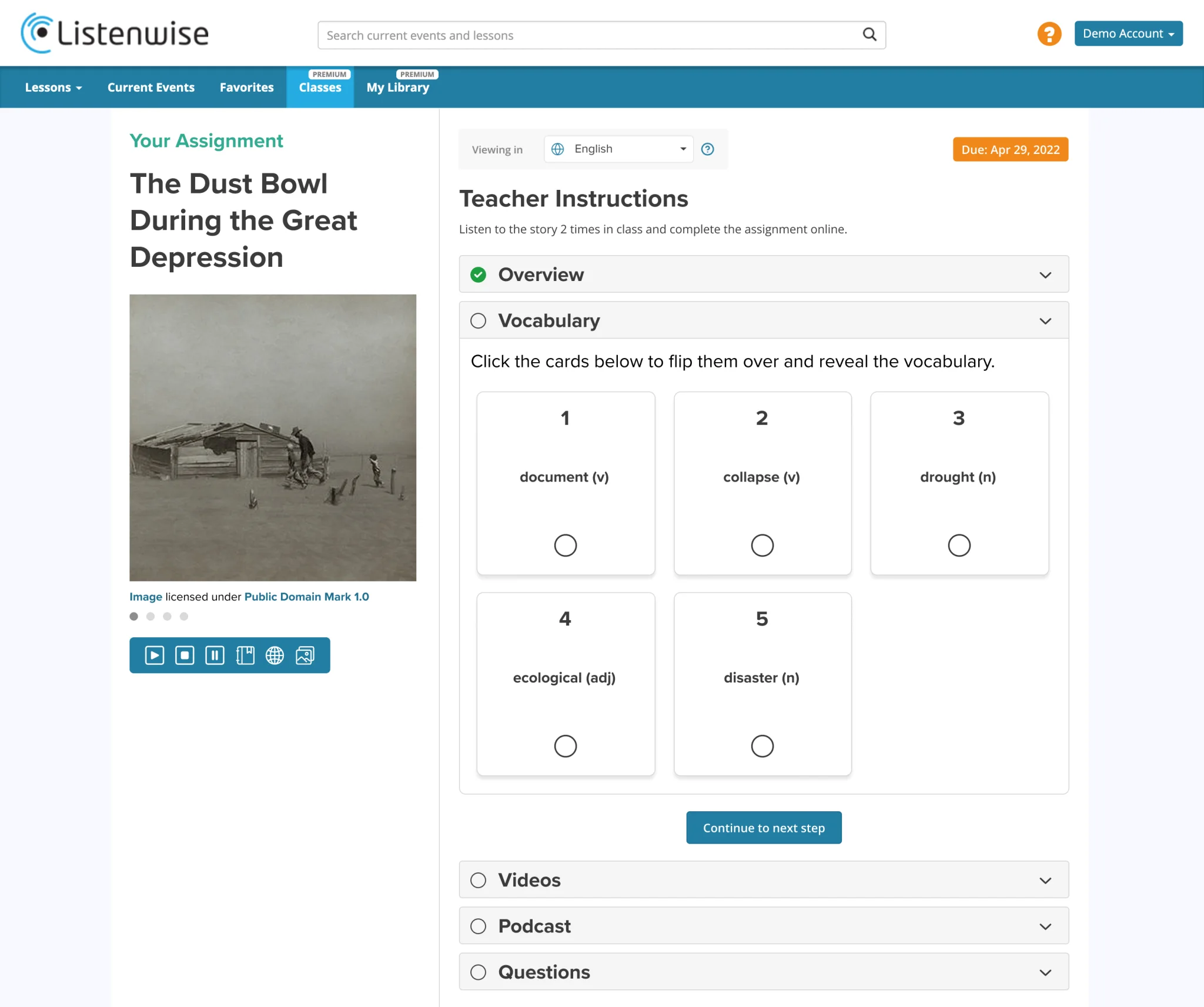
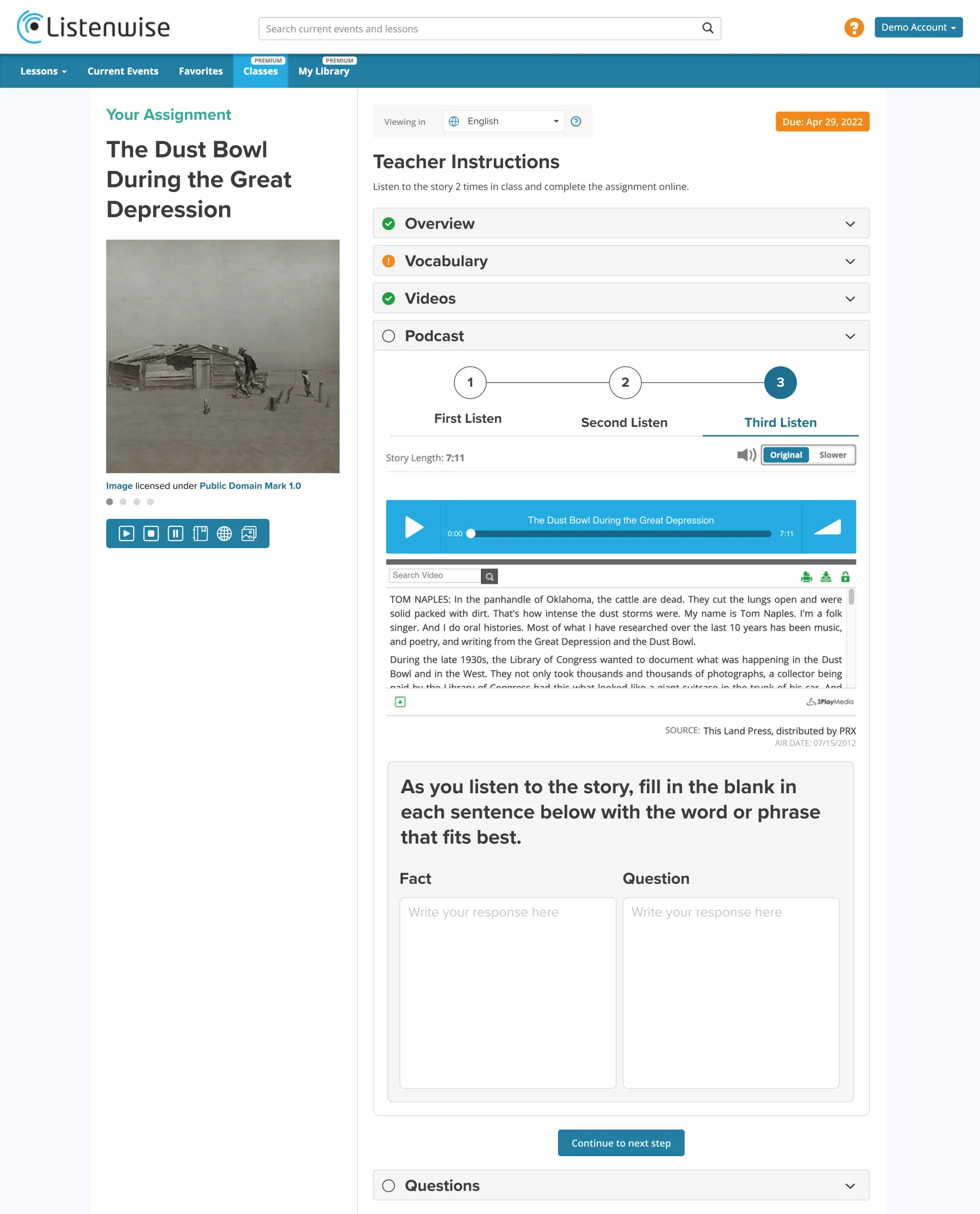
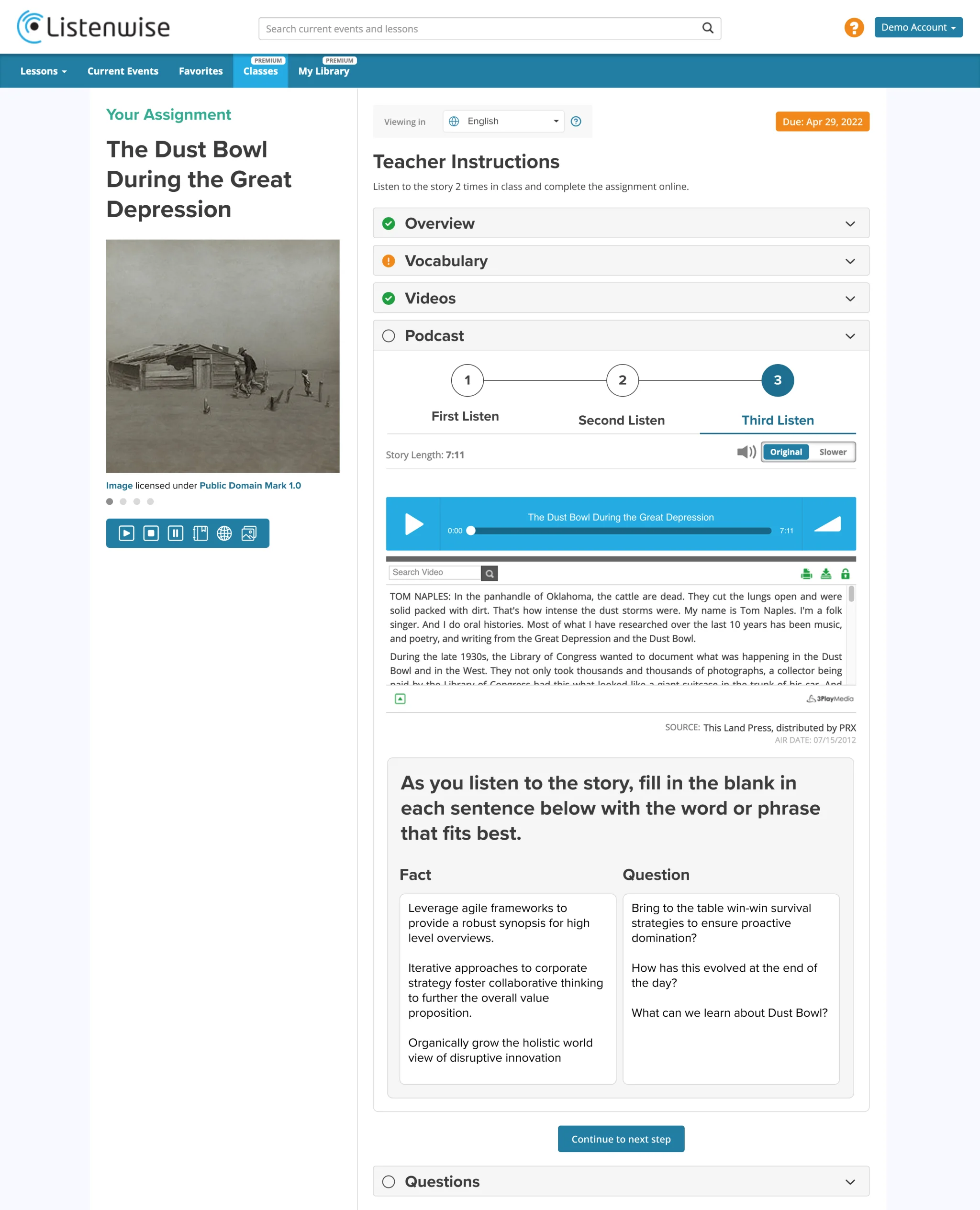
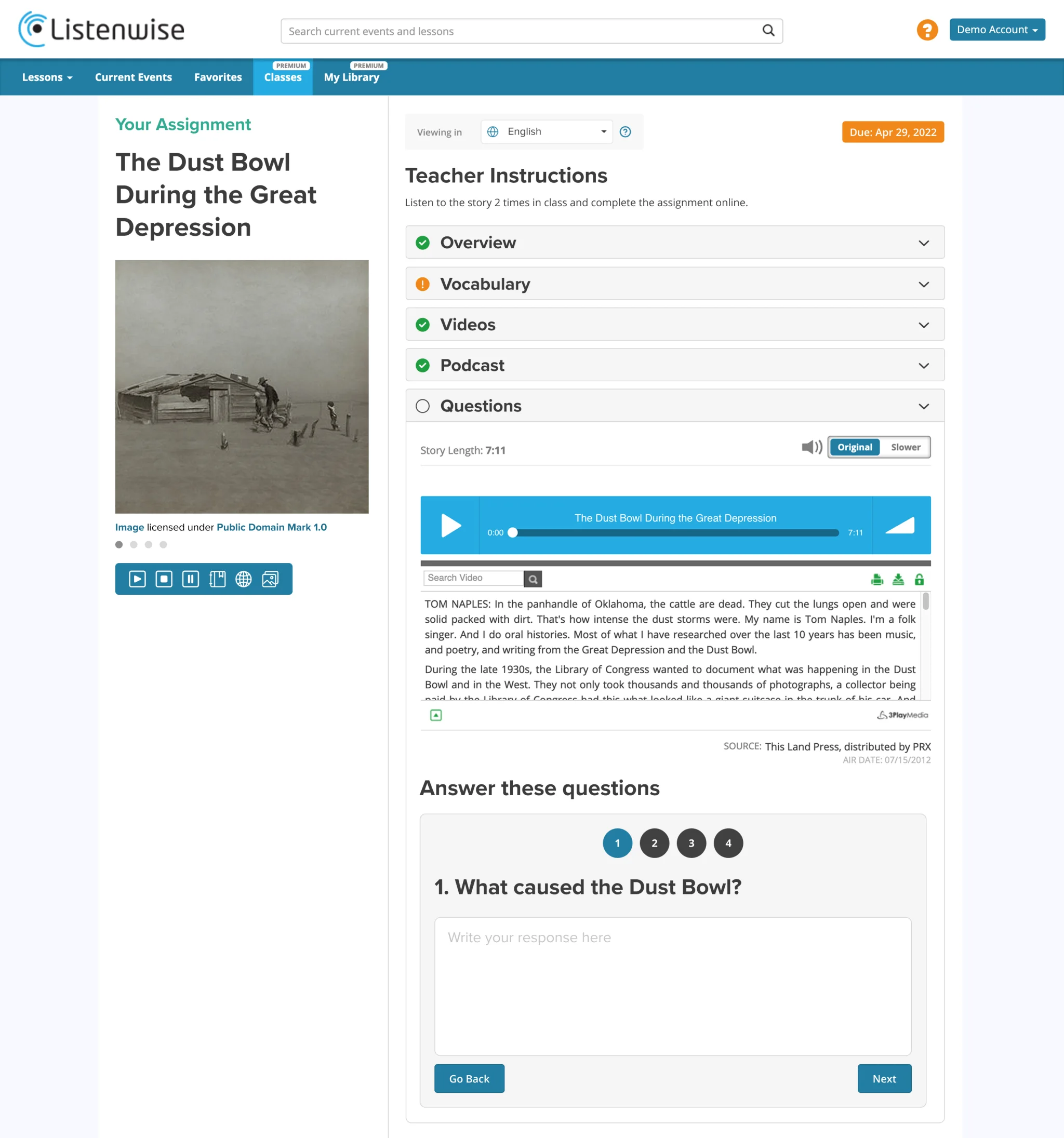
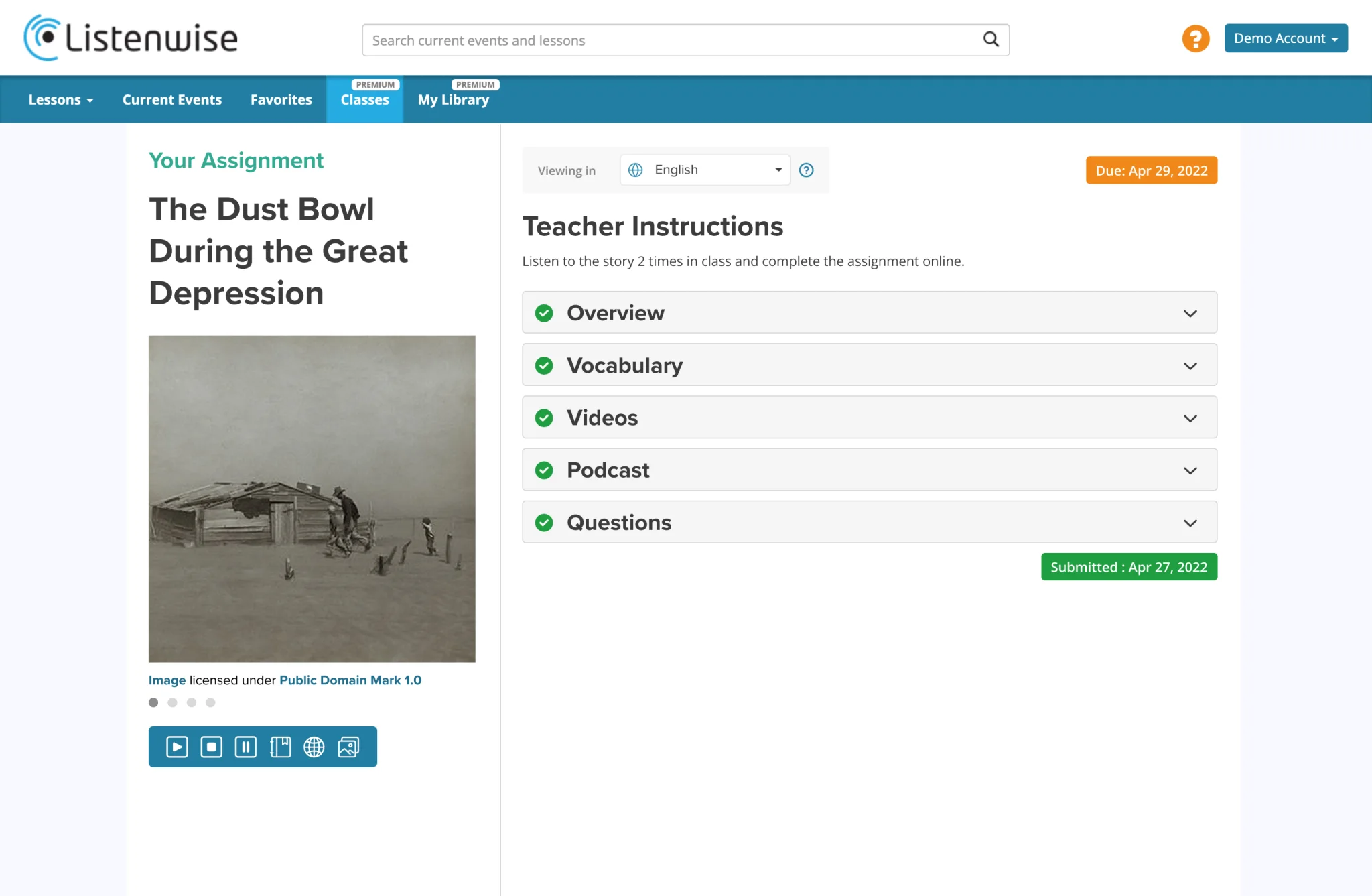
The assignment I reviewed uses a long page of collapsible sections, with separate activities for three listening passes through a seven-minute story. Questions aren’t linked to the relevant passage, so checking a detail means finding it in the recording or transcript.
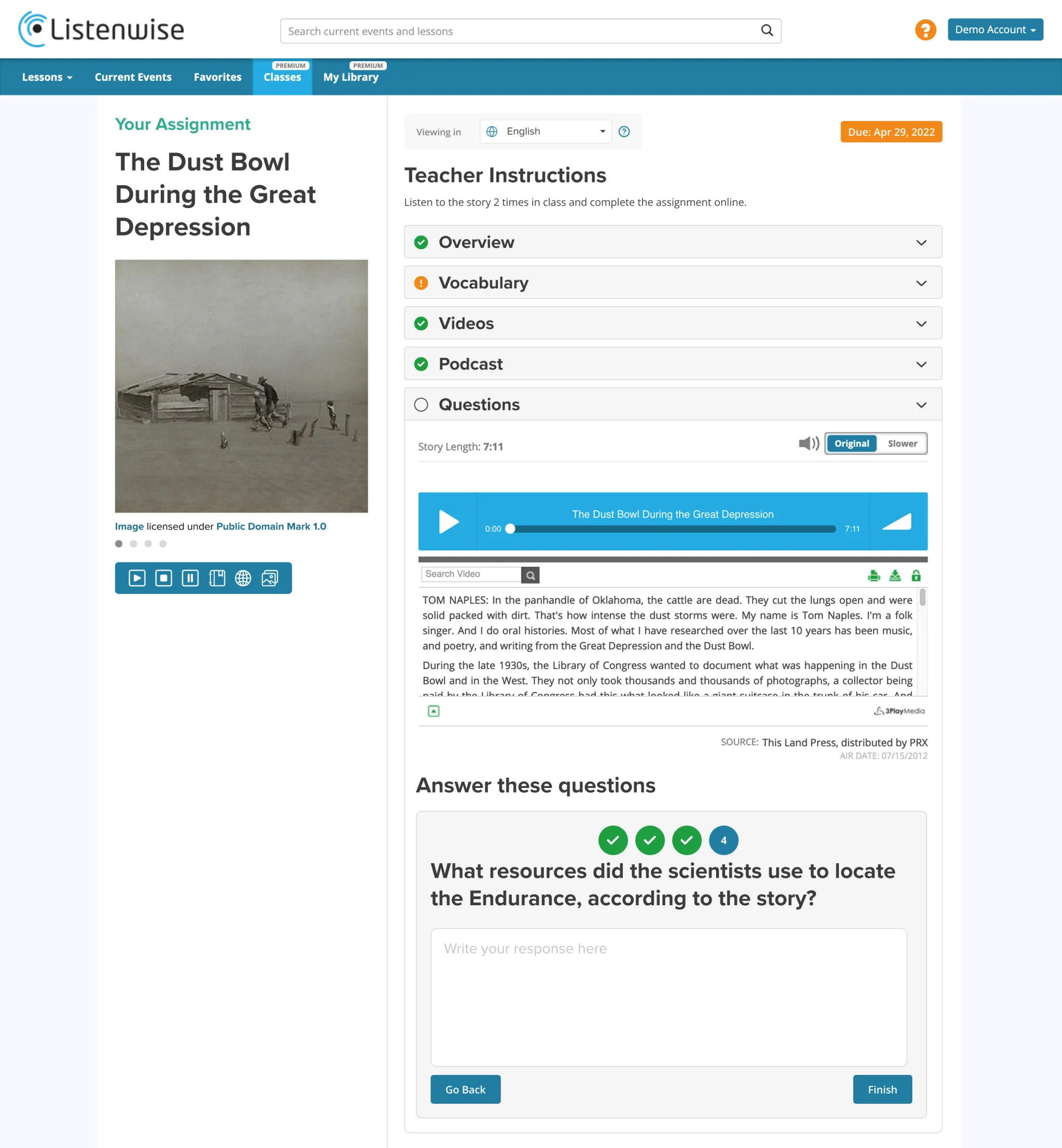
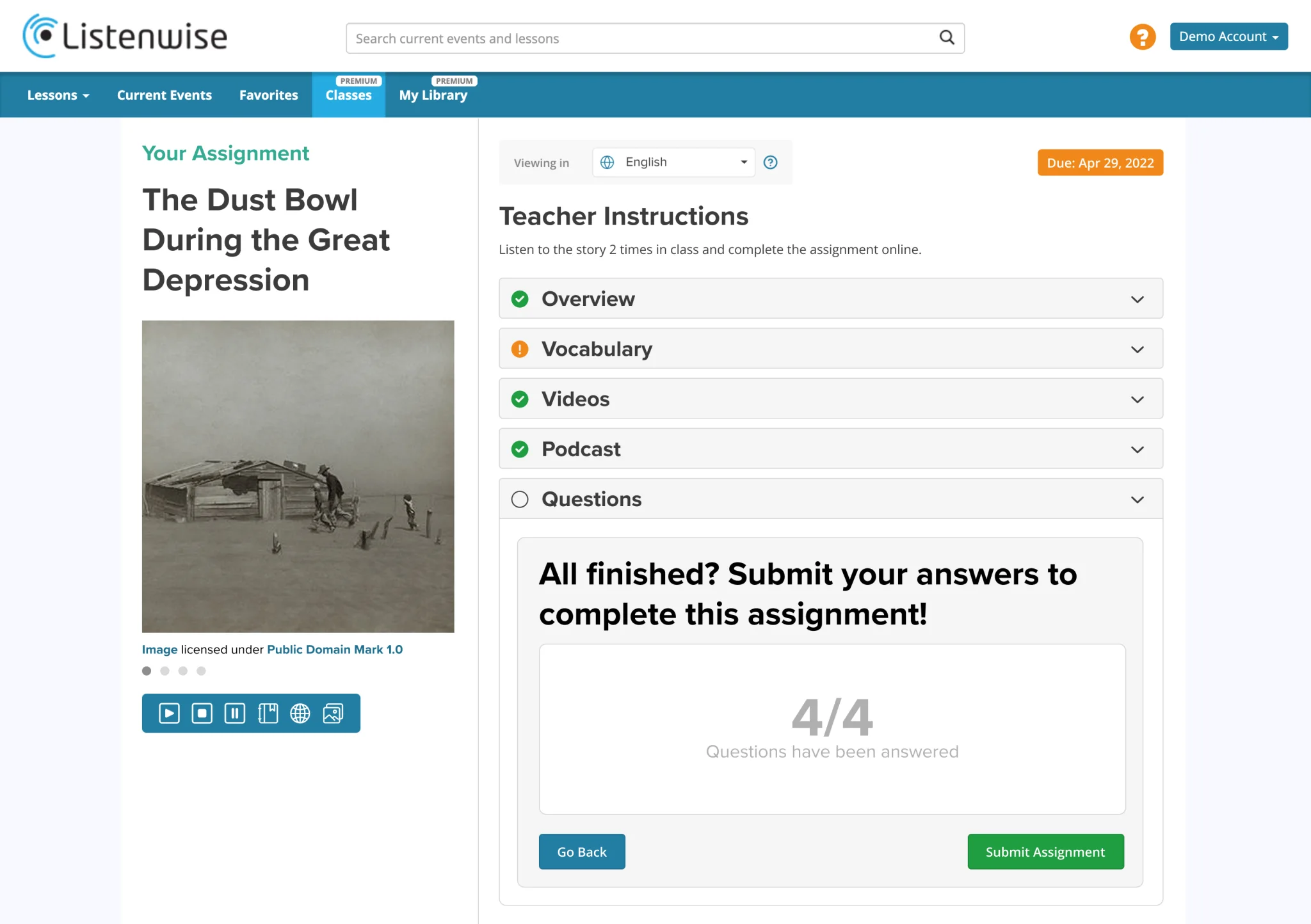
Before submitting, students see a count of answered questions, not the answers.
My starting point was to modernize an interface built around stacked sections, repeated players, and questions shown one at a time. The audit below records the patterns I wanted to revisit. I explored a clearer visual hierarchy, a shared space for listening and writing, and more explicit progress and saved-work states. These are design proposals based on reviewing the interface; their effect on students still needs testing.
The goal: keep the question, the evidence, and the next step on the same screen.
What changed
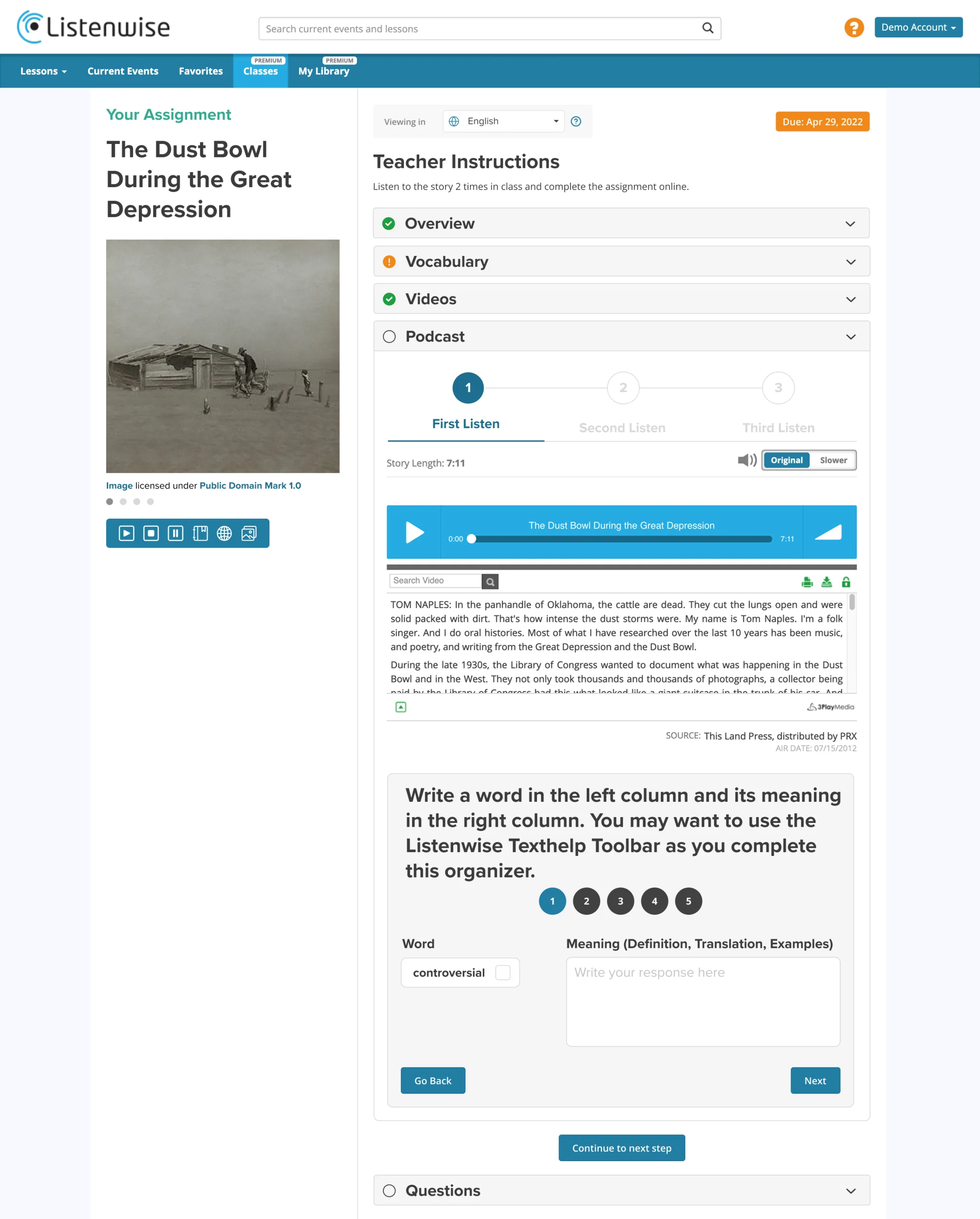
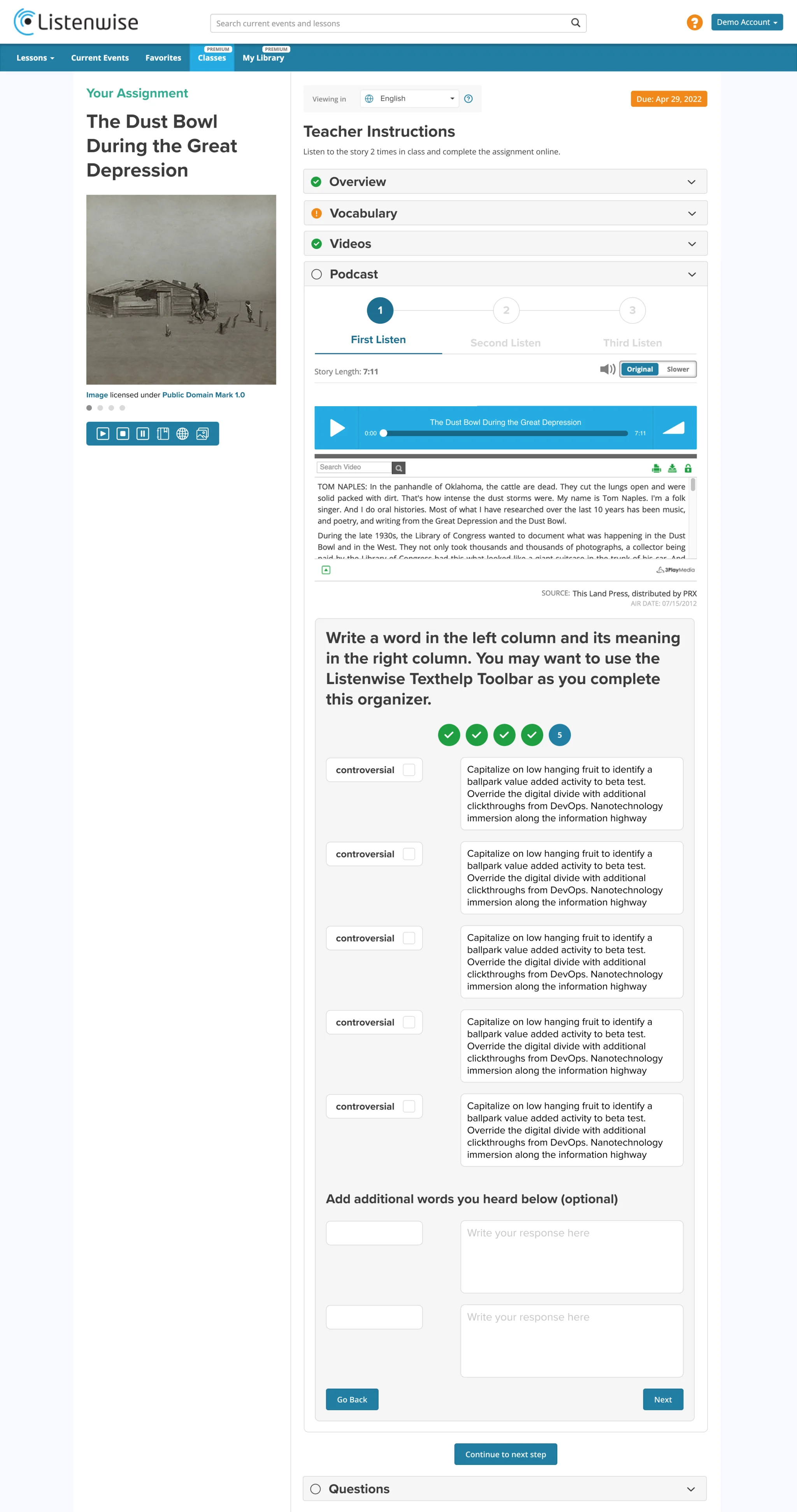
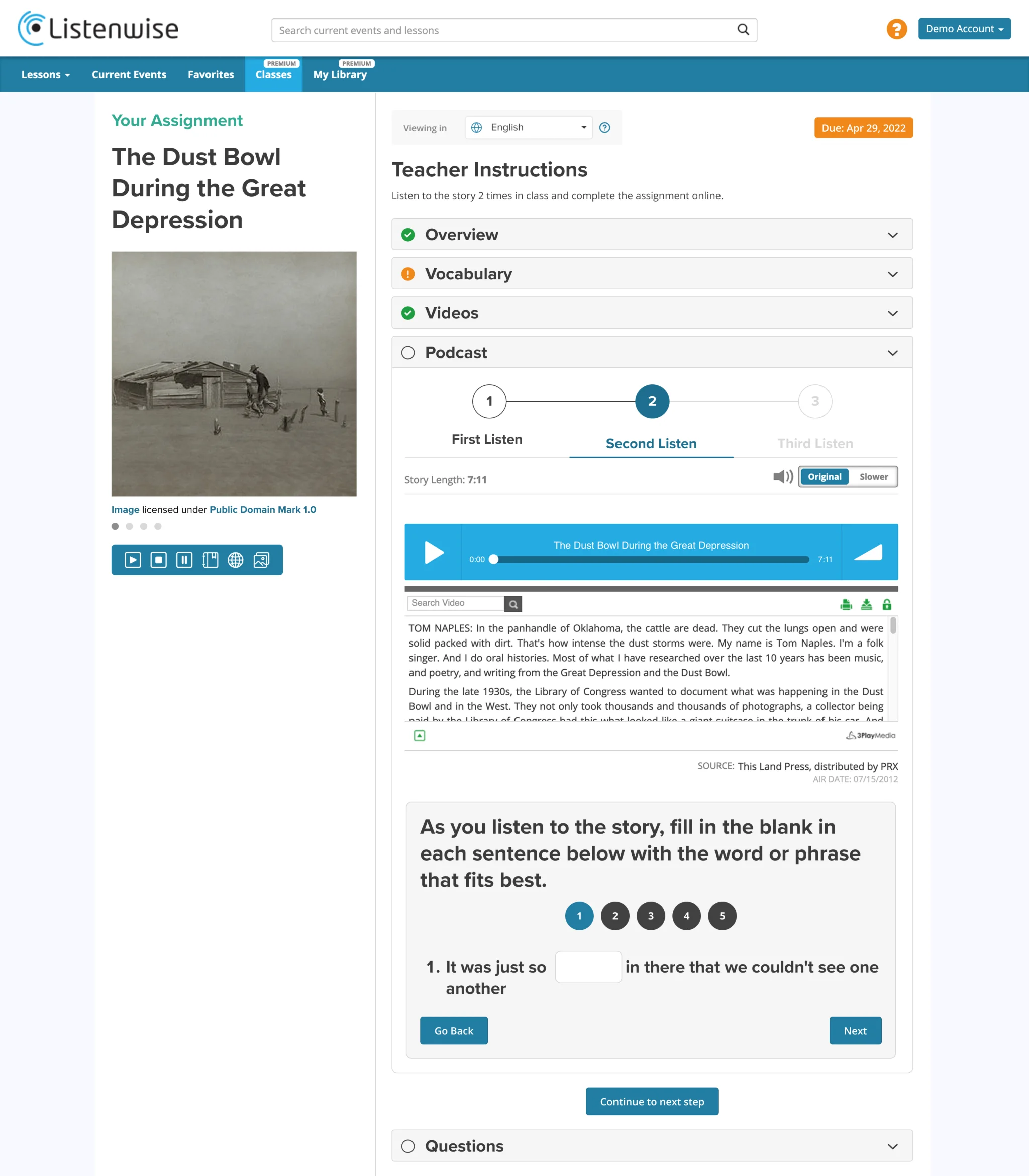
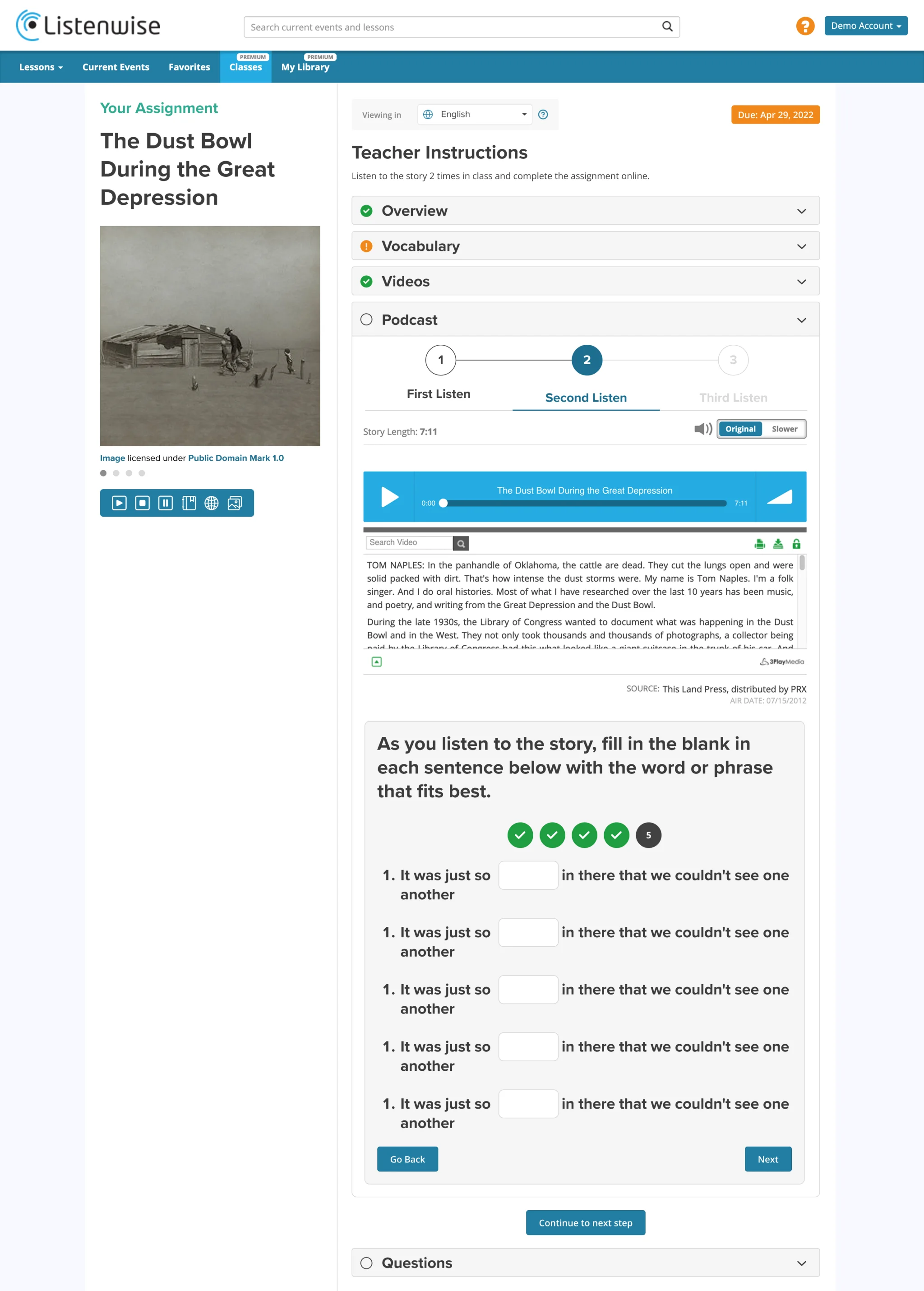
Design decisions
A listening notebook sits beside the story, so students find a detail without leaving the question. Vocabulary stays a tab away.
Each question links to its passage, and every transcript line replays on tap. Another listen means checking one detail, not replaying seven minutes.
Progress is always visible, drafts save as students type, and every answer comes together on one review screen before submitting.
Optional sentence starters and an everyday-life prompt give students a way in without supplying the answer.
A closer look · Reviewing work
The original screen confirms how many questions have been answered. I wanted the final step to help students check the answers themselves, with room to make changes before submitting.
Original · Answer count
Proposed · Answer review (Focused)
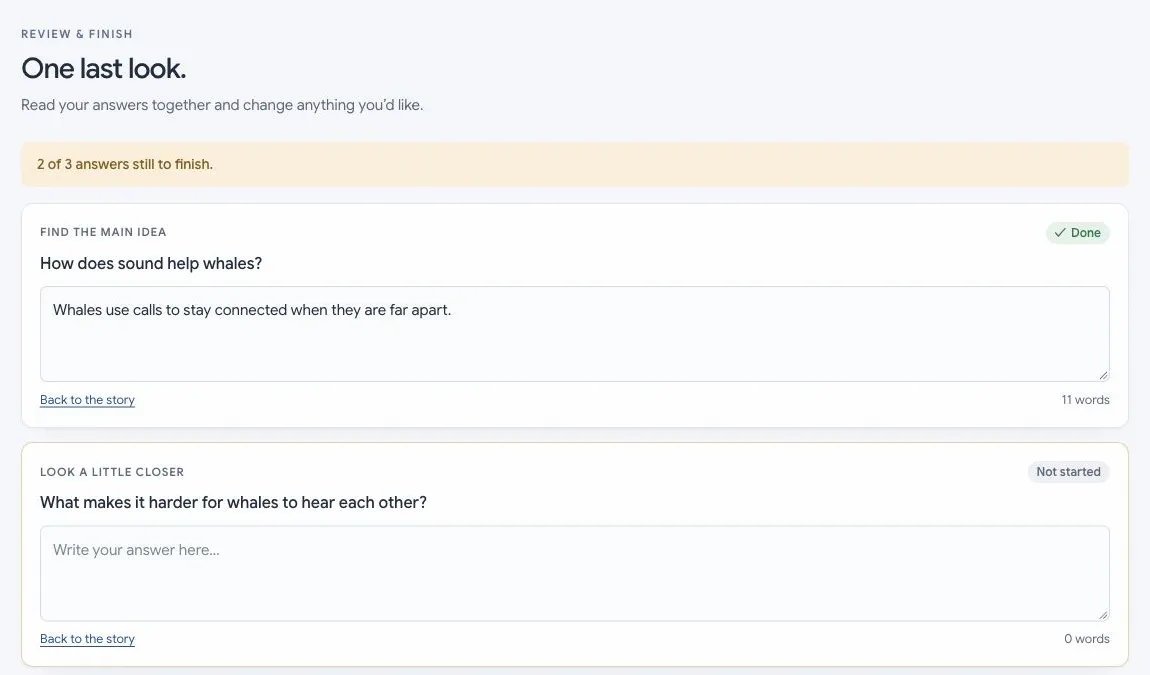
Cropped views from different lessons; the proposed screen uses an illustrative answer. Select either image to enlarge it.
The question to test: does reviewing answers together help students catch omissions and revise their work before submitting?
Two directions
Both concepts share the core decisions above: four stages, the story beside the notebook, replay links, saved drafts, and one review screen. They differ in how much the interface guides students through the work. Switch between them with the Guided and Focused toggle above the prototype.
Guided
Structure
A sidebar lists the four stages with their purpose and keeps progress in view.
Home
One featured assignment, with a question to think about before listening.
Get ready
A quick-think check and flip cards that students open one word at a time.
Tone
Larger headings, warm prompts, and encouragement at each step.
Intended for younger students and anyone new to the flow. Tradeoff more on screen, and definitions sit behind a tap.
Focused
Structure
A compact stepper above the work leaves the full width for the story and answers.
Home
An assignment list grouped by due this week, coming up, and completed.
Get ready
All three words visible at once, plus a prediction that returns after listening.
Tone
Plain, task-first copy with fewer decorative elements.
Intended for students who know the routine and juggle several assignments. Tradeoff Fewer prompts to guide students through each step.
Guided could support students through their first few assignments, with Focused available once they know the routine. I’d test whether that transition is useful.
Tradeoffs and next steps
Next, I’d run moderated sessions comparing the current flow with both concepts on the same lesson: completion, use of replay links, answers that cite the story, and missing answers at submission, looked at by grade.
Current flow audit
Thirteen captured views of the assignment I reviewed, including empty and completed states of the same activities. Each shows what the interface asks of students, what I noticed, and the design question it raised. The views are grouped by the proposed stage.